
Guoxiu Wang
Attorney-at-Law
Beijing Wei Chixue Law Firm
Attorney-at-Law
Beijing Wei Chixue Law Firm
This article explores whether the interior and exterior design of a commercial store can be legally protected and how to enforce their rights in cases of “being copied,” based on existing legal provisions and relevant judicial precedents.
I. Legal Bases for Protecting Interior and exterior Design of a Commercial Store
·Trademark Law
Trademark sign and logo of commercial stores may be protected under trademark law. However, the overall interior and exterior design of the store composed of a combination of various elements is difficult to protect under trademark law. In practice, infringers often copy or imitate a rights holder’s trademark along with its store interior and exterior design , and rights holders frequently assert both trademark infringement and unfair competition claims in such cases.
·Patent Law (Design Patent)
Since the interior and exterior design of a commercial store is not affixed to an independent product, its entirety is difficult to protect under design patent. However, for instance, if a design patent is granted to a store signage, it could be enforced against similar signage used by others.
·Copyright Law
If the interior and exterior design of a commercial store—consisting of spatial layout, colors, lines, shapes, display, ornamentation and other elements—is original and constitutes a work of fine art, it may be protected under copyright law. However, this does not mean that all decorations qualify for copyright protection. To be recognized as a work of fine art under copyright law, a commercial store’s decoration design must at least satisfy the following three conditions: first, it must possess aesthetic appeal, and such aesthetic appeal must be separable from its practical functions; second, it must meet the requisite level of originality for a work of fine art. On the premise that the work in question satisfies these conditions, copyright infringement shall be further determined based on the standard of "access" plus "substantial similarity".
China adopts the “automatic protection” principle for copyright, meaning copyright arises automatically upon completion of a work. Nonetheless, it is advisable to voluntarily register copyrights after finalizing the design. Registration fees and time costs are modest—based on our firm’s experience, registration certificates are usually issued about one month after filing. Moreover, copyright registration certificate serves as prima facie evidence of ownership in enforcement actions.
A search of copyright registration database reveals records of fine art works with titles such as “Store design,” indicating that registering store design renderings as copyright works is practically feasible.
·Anti-Unfair Competition Law
In practice, protection under Article 7 of the Anti-Unfair Competition Law is typically sought for product names, packaging and decoration, and even product configurations. The 2022 judicial interpretation extended the scope of “decoration” to include the overall business image of a commercial store (i.e., a distinctive overall business image formed by elements such as store decoration, style of business utensils, and staff attire). Accordingly, where the overall business image formed by a store’s decoration constitutes “decoration with certain influence,” it is protectable as a legitimate right and interest under anti-unfair competition law.
II. Case Studies on Commercial Store Interior and Exterior Design
The author has reviewed cases where rights holders sued infringers for copyright infringement or unfair competition based on “copying” or “imitating” store interior and exterior design , and selected a few involving stores targeting general consumers.
Case 1i: Jewelry Store Interior and Exterior Design Protected Under Copyright Law
Plaintiff’s store interior Defendant’s store interior
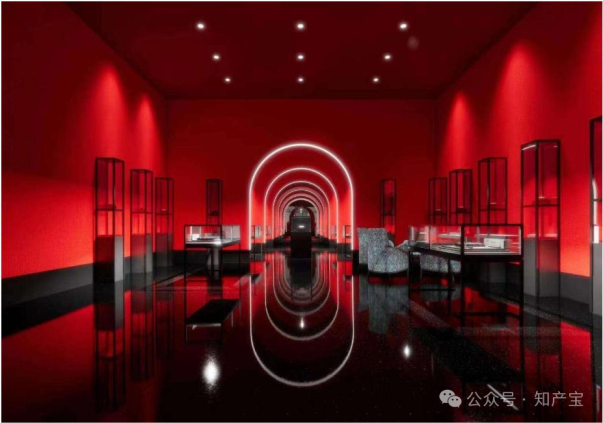
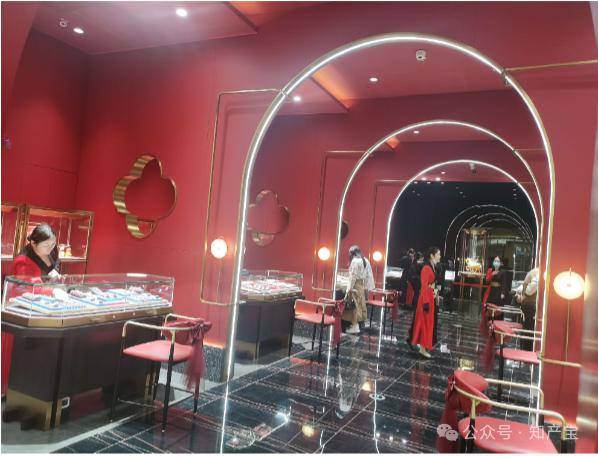
In this case, the plaintiff engaged a third-party design company to create the interior design for its jewelry store, and after completing the design, opened the store accordingly. The plaintiff also registered its store image as a fine art work with the copyright authority. Later, the plaintiff discovered that the defendant had opened a jewelry store with a similar interior design and had prior access to the plaintiff’s design. The plaintiff sued for copyright infringement. The defendant argued that the plaintiff’s work lacked originality and that the two designs were not substantially similar. The Beijing Intellectual Property Court held:
“Although the author used elements commonly found in the public domain, such as red and black colors and multiple arched doorways, by arranging these elements into a corridor with progressively layered arched partitions, embedding white LED strips along the edges of the arches, placing a mirror at the end of the space, and combining this with red walls and ceilings and a black reflective floor, the design created a unified visual effect that enhanced the spatial depth and layering. The above design reflected the author’s selection, arrangement, and composition, and possessed a certain degree of originality. Therefore, the work met the originality requirement under copyright law and was entitled to copyright protection.
When comparing the plaintiff’s work with the defendant’s store design, the differences lay mainly in the presence of “flower-shaped” openings between each arched partition, variations in counter shapes and materials, and white veining on the defendant’s black floor. However, when viewed as a whole from the perspective of an average consumer, these differences did not result in a materially different visual impression. Therefore, the two designs were substantially similar.”
Thus, even if a work incorporates elements from the public domain, the original expression resulting from the author’s arrangement and composition may still be protected by copyright. In assessing substantial similarity, the focus should be on whether the allegedly infringing design appropriates the original elements of the plaintiff’s work, judged from the overall visual impression of an ordinary observer.
Case 2ii: Decathlon v. Fujian Company (Unfair Competition)
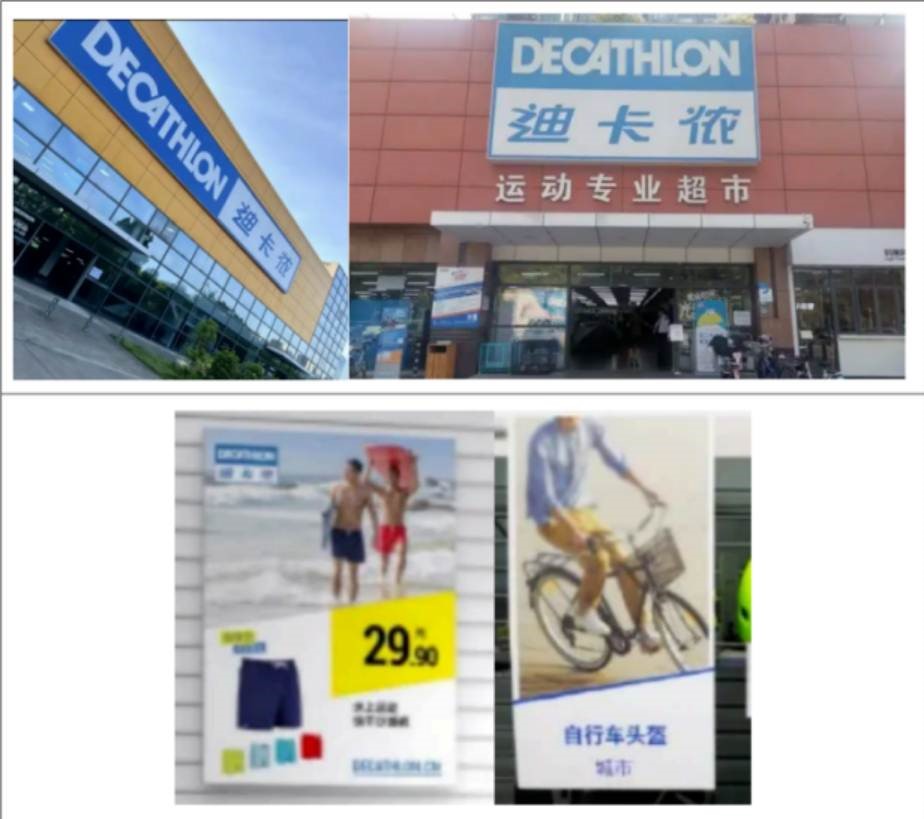
(Decathlon’s storefront)
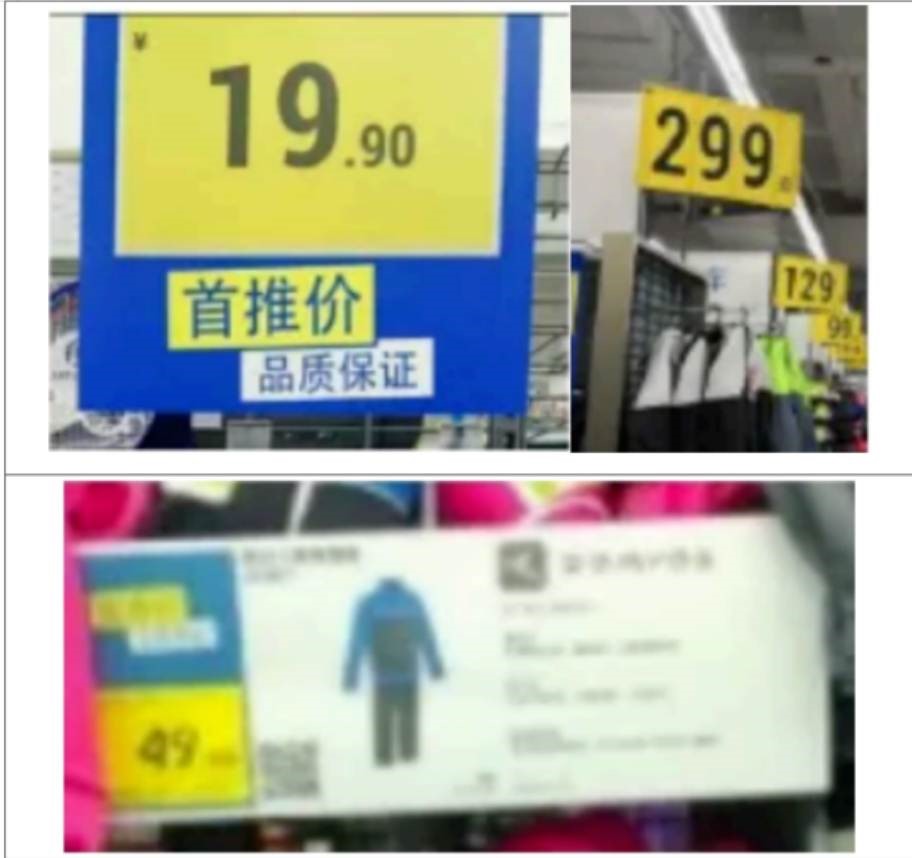
Decathlon claimed that its sportswear store interior and exterior design constituted “decoration with certain influence” under the Anti-Unfair Competition Law, and brought an unfair competition claim against a similarly operated sportswear store with a similar design. The main issues were whether Decathlon’s store design was distinctive, and whether the defendant’s design was likely to cause consumer confusion. The first-instance court found no likelihood of confusion, but the second-instance court reversed, holding that Decathlon’s design served to identify the source of its services and constituted distinctive decoration under the Anti-Unfair Competition Law. The appellate court emphasized that while generic elements may be freely used and learned from, a distinctive decoration that identifies the source of goods or services, especially one used first by another, cannot be imitated in a manner likely to cause market confusion or misidentification. The second-instance court awarded Decathlon RMB 2 million in economic damages and reasonable expenses (This case also involves the defendant’s acts of false advertising and other misconducts, and the said amount represents the total compensation).
The second-instance court found:
“Decathlon’s claimed store decoration formed a distinctive overall image unrelated to functional features. Through long-term use and extensive promotion, this decoration had become sufficiently associated with Decathlon stores in the minds of relevant consumers, serving to identify the source of services, and thus constituted distinctive packaging and decoration protectable under the Anti-Unfair Competition Law.
The decoration of the plaintiff and defendant were similar in both overall style and specific elements, including the details of facade advertisements, posters, and athletic figures. When the relevant public, exercising ordinary attention, can hardly perceive the differences between the two, the decoration of the two shall be deemed similar.”
The retrial court affirmed the second-instance judgment, noting that the defendant had engaged in promotional activities likely to cause confusion:
“Given that the defendant repeatedly described itself in its marketing as “the Decathlon of the sports and outdoor brand franchise sector,” its use of a store decoration similar to Decathlon’s was likely to cause confusion among relevant consumers, who might mistakenly believe there was a licensing or affiliation relationship between the two.”
Case 3iii: Decathlon v. Beijing Company & Guangdong Company (Unfair Competition)
Decathlon brought a similar unfair competition claim in this case but obtained the opposite result. The court ruled against Decathlon primarily because the 22 decoration elements it claimed were not used consistently or uniformly across its stores. In other words, the 22 elements were selected from various stores across different periods and locations, and no single store actually used all 22 elements together as a coherent whole.
III. Conclusion
For commercial store interior and exterior design to be protected under copyright law, the key is whether the design meets the originality threshold under copyright law. Business operators should preserve evidence of ownership from the initial design stage and obtain copyright registration certificates to facilitate future enforcement.
To seek protection under the Anti-Unfair Competition Law, it is essential to understand that “decoration with certain influence” under that law is not defined by individual elements but by the overall business image formed through the selection, arrangement, and combination of various elements. Even if generic elements are included, protection may still be available if the overall image is distinctive enough to identify the source of goods or services, thereby prohibiting others from imitating or using similar decoration. Additionally, operators of chain stores with outlets in multiple regions should ensure consistent, stable, and uniform use of common elements across all stores. When asserting rights in litigation, it is advisable to focus on those common elements used uniformly across stores to increase the likelihood of success.
————————————————————————————————————————————————
i First Instance: (2023) Jing 0105 Civil First No. 35342; Second Instance: (2024) Jing 73 Civil Final No. 1868
ii First Instance: (2020) Wan 02 Civil First No. 110; Second Instance: (2021) Wan Civil Final No. 1478; Retrial: (2023) Wan Civil Retrial No. 6586
iii First Instance: (2021) Jing 0107 Civil First No. 15817; Second Instance: (2023) Jing 73 Civil Final No. 994